
Table of Contents
- What Makes Automotive Streetwear Authentic: A Working Definition
- Genuine Enthusiast Design vs Generic Car-Themed Merchandise
- Fabric, Construction, and the Print Quality Test
- Authentic Automotive Clothing Brands: How to Tell Who Actually Belongs
- Car Meet Outfits That Read as Legit, Not Costume
- How to Style Car Graphic Tees Without Looking Like You Tried Too Hard
- Cultural Accuracy, Community Accountability, and Ethical Production
- Frequently Asked Questions
Last Updated: October 18, 2026
What Makes Automotive Streetwear Authentic: A Working Definition
Automotive streetwear is authentic when the design knowledge comes from people who actually participate in car culture, and when the garment is built to survive that culture. That rules out a lot of what gets sold as car apparel.

Below, we'll show you how to evaluate authenticity before you spend money, using six verifiable checks, a design-detail breakdown, and construction tests that reveal whether a tee will last a season or a decade.
The Authenticity Checklist: Six Things to Verify Before You Buy
Use this checklist as a pre-purchase filter. It works on any brand, at any price, in any country.
- Specific subject matter. The design references a real model, generation, engine, or event, not a generic "fast car" shape. Ask which chassis the graphic depicts. If the answer is vague, so is the design.
- Stated garment specs. The listing names fabric weight, composition, and construction. Honest materials get described, not implied.
- Print method disclosed. Screen print, DTG, or embroidery, stated plainly. Cracked graphics usually trace back to a method chosen for cost, not longevity.
- Visible community presence. The brand shows up at meets, supports events, or documents its involvement. Not just a repost of someone else's photo.
- Named accountability. A real contact, a real returns policy, a real person answering questions. Anonymous storefronts have nothing to lose.
- Design consistency. The catalog holds together as one point of view instead of chasing every trend at once.
That last item matters more than people expect: a coherent aesthetic signals an editorial voice, while forty unrelated designs signal a dropship operation.
Genuine Enthusiast Design vs Generic Car-Themed Merchandise
Genuine enthusiast design starts with a specific car and works outward. Generic car-themed merchandise starts with a trend and works backward to whatever silhouette is easiest to license.
The difference shows up in the references. An enthusiast-led brand names a generation code, reproduces a wheel design accurately, or builds a graphic around a real motorsport event. A generic operation uses a low-slung sports car outline that matches no actual model, because accuracy was never the goal.
What most guides miss is that inaccuracy is a design decision. A brand that can't get the car right won't bother with the fabric either; sloppiness is consistent across a product line.
Design Details That Give It Away
Look closely at the graphic itself. These details separate a designer who knows cars from one who ran a search for "car vector."
- Proportions. Wheels sit correctly in the arches. Ride height matches the actual car.
- Badging and typography. Period-correct fonts, accurate placement, no invented logos.
- Color references. Legendary racing liveries are reproduced faithfully, not approximated.
- Negative space. Clean design uses restraint. Cluttered graphics usually compensate for weak ideas.
- Sleeve and back prints. Extra print placement costs more to produce and signals a brand investing in the garment.
Our own approach at Midnight Motor Club is deliberately clean. We'd rather a design read clearly across a parking lot than cram five references onto one chest print.
Fabric, Construction, and the Print Quality Test
Fabric and construction decide whether a shirt survives car culture or becomes a rag by August. Two garments can look identical online and behave completely differently after ten washes.
Here's what to check, in order of how much it matters:
| What to Check | What Good Looks Like | Why It Matters |
|---|---|---|
| Fabric weight | Substantial hand feel, stated in the listing | Thin cotton pills, stretches, and shows through |
| Composition | Named fiber blend, not "premium cotton" | Blends hold shape better over repeated washing |
| Stitching | Double-needle hems, reinforced shoulder seams | Single stitching fails first at stress points |
| Print method | Screen print or embroidery, disclosed | Cheap transfers crack and peel quickly |
| Shrinkage | Pre-shrunk or stated shrinkage rate | Unstated shrinkage means guessing your size twice |
The print test is the one buyers ask about most. A graphic that cracks after a handful of washes was never printed to last. Screen printing pushes ink into the fabric; direct-to-garment printing sits on top.
Ask the question directly before you buy: what happens to this graphic after twenty washes? A brand that can answer specifically is a brand that thought about it.
Authentic Automotive Clothing Brands: How to Tell Who Actually Belongs
Authentic automotive clothing brands prove membership in the culture rather than claiming it. The proof is public and usually boring: event attendance, community relationships, and a track record predating the current trend cycle.
Ask where the brand shows up. Enthusiast-led operations appear at car meets, support grassroots events, and build relationships with builders and drivers rather than influencers alone. Industry engagement leaves a trail you can check in minutes.
Then check the language. Brands inside the culture talk about chassis codes, fitment, and specific builds without explaining them. Brands outside it explain the references to you, because they learned them from a research document.
"Built For Street" Car Culture Tee →
Car Meet Outfits That Read as Legit, Not Costume
Car meet outfits work when the apparel supports the night instead of competing with it. The goal is to look like you belong there, not like you dressed for a photo shoot in the same lot.
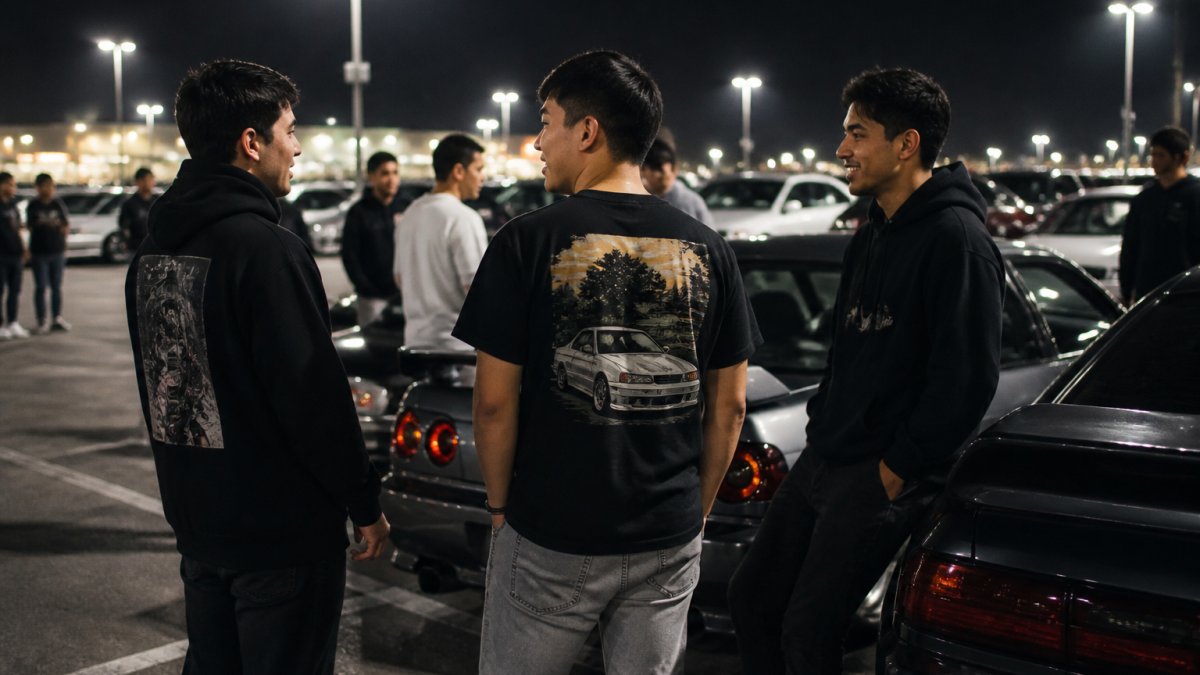
A few principles hold up across every scene:
- One focal piece. A strong graphic tee carries the outfit. Everything else stays quiet.
- Layers over statements. A hoodie or overshirt adds texture without adding noise.
- Weather-appropriate, always. Nobody at a cold-weather meet trusts a guy in shorts.
- Comfortable footwear. You will be standing for hours and walking between rows.
- Clean, not costume. No fake racing suits, no sponsor patches you didn't earn.
The costume problem is real: a full racing-inspired outfit at a casual meet reads as trying too hard. A well-made graphic tee, dark denim, and a weather-appropriate jacket will always land better than a themed ensemble.
How to Style Car Graphic Tees Without Looking Like You Tried Too Hard
Styling car graphic tees is a credibility exercise, not a fashion one. People at a meet read your outfit the way they read a build: does it look intentional, earned, and like you actually drive the thing. The shirt is already doing the talking, so the rest of the outfit should stay out of its way. Here's the automotive-specific version.
Start with fit, because fit is the first authenticity signal. A tee that's too tight reads as costume; one that's too loose reads as careless. Aim for a clean shoulder seam and a hem that hits mid-fly. From there, the rules that actually matter in car culture:
- Match the shirt's era and scene. A clean, minimal JDM-inspired graphic pairs with dark denim, a plain overshirt, and simple sneakers. A loud, retro racing-livery print pairs with workwear trousers and a neutral jacket. Mixing a period-specific graphic with an outfit from a different subculture reads as a costume rack, not a wardrobe.
- Let one reference carry the fit. If the tee references a specific chassis, don't also wear a cap with a different marque, a lanyard with a third logo, and shoes with a fourth. Enthusiasts read stacked references as trying too hard. One accurate reference beats four approximate ones.
- Skip the props. Fake sponsor patches, unearned racing suits, and lanyards from events you didn't attend are the fastest way to get read as a costume. The costume problem is real: a well-made graphic tee, dark denim, and a jacket that suits the temperature will always land better than a themed ensemble.
- Dress for the actual conditions. Nobody at a cold-weather meet trusts a guy in shorts. Layers over statements, a hoodie or overshirt adds texture without adding noise, and it signals you've been to a meet before.
- Keep footwear practical. You will be standing for hours and walking between rows. Clean, comfortable sneakers or boots read as someone who came to be there, not someone who came to be photographed.
Everyday wear matters too. The best automotive streetwear earns its place in a normal rotation, not just at events. A tee that works at a meet and at a coffee shop the next morning is a real garment, and that versatility is itself an authenticity signal.
Cultural Accuracy, Community Accountability, and Ethical Production
Cultural accuracy means representing car culture honestly, including the parts that are easy to get wrong.
The subject. A design should reference a real model, generation, engine, or event, not a generic silhouette.
The context. Respectful use of regional scenes means understanding what a reference means to the people who lived it.
The credit. Community accountability is the other half.
Ethical production ties in directly. Honest materials, disclosed construction, and willingness to answer questions about how a garment was made all respect the people who buy it.
That's the standard we hold ourselves to at Midnight Motor Club: clean design, honest materials, and products built to last longer than the trend that inspired them. Our Built For Street car culture tee and Cars and Coffee graphic t-shirt are designed for exactly this, everyday wear that holds up at the meet and everywhere after.

Frequently Asked Questions
What makes automotive streetwear authentic?
Authenticity comes down to three things: design that shows real car knowledge, materials that survive actual wear, and a brand that participates in the scene rather than just selling to it. Look for specific references (a chassis code, a wheel style, a livery color) instead of generic flame or piston graphics. Check that the print method and fabric are named, and see whether the brand shows up at meets, sponsors builds, or answers questions publicly. If a company can't explain its own references, it's merchandising, not culture.
How can you tell if an automotive clothing brand is authentic?
Start with the product page. Genuine automotive streetwear brands list fabric weight, print method, and fit, and they show the garment on real people. Next, check the references: accurate model names, correct livery colors, and details that only someone who has been under a hood would include. Then look at community behavior. Do they attend car meets, reply to comments with substance, or publish anything beyond product drops? Finally, ask about production. A brand willing to say where and how the shirt is made is usually the one that isn't hiding anything.
How do you style car graphic tees for a car meet?
Keep the tee as the loudest element and mute everything else. A graphic tee with dark denim or work pants, a plain overshirt or bomber, and clean sneakers reads as intentional. Match the graphic's color to one other item, like a cap or a jacket, so it looks composed rather than random. Avoid stacking multiple car logos at once. For late-night meets, a heavyweight tee under an open flannel or zip hoodie handles cold parking lots and still looks put together when you unzip.
Why do authentic automotive tees cost more than generic car shirts?
The difference is usually in the blank and the print. Heavier interlock or ring-spun cotton holds shape through washes, and screen-printed or embroidered graphics resist cracking better than cheap heat transfers. Those materials cost more up front, which shows up in the price. A $29.99 tee from a brand like Midnight Motor Club is priced for a garment meant to be worn weekly, not a novelty shirt that fades after five washes. Compare fabric weight and print method, not just the sticker price.