How Do You Actually Get Into JDM Car Culture?

Last Updated: November 5, 2026
Quick Summary
You get into JDM car culture by learning the vocabulary first, then showing up to meets and asking owners about their cars. No car is required to join: pick three iconic models, learn their generations and engine codes, follow real builds, and attend one meet this month.
- True Japanese-market vehicles have different engines, features, and specs than Japanese-branded cars sold elsewhere.
- Start by learning three iconic cars, their generations, and their engine codes.
- Find meets through local community groups, parts shops, tuning garages, and social media.
- Ask before touching a car, keep it legal, and save speed for sanctioned track days.
- Spectators can enjoy meets for free or a small entry fee before buying anything.
Table of Contents
- JDM Car History: Why This Scene Exists
- JDM Cars for Beginners: Models Worth Knowing
- How to Join the Community Without Owning a Car
- Finding JDM Car Meets and Fitting In
- Car-Meet Etiquette, Safety, and Legal Boundaries
- JDM Car Culture on a Budget: What It Really Costs
- Gear That Shows You Belong
- Your First Step: Show Up to One Meet This Month
- Frequently Asked Questions
JDM Car History: Why This Scene Exists
JDM car culture is the global community built around Japanese domestic market vehicles: cars designed and sold in Japan, then celebrated worldwide for their engineering, tuning potential, and style. Here's how to get into JDM car culture without feeling lost.
The story starts in postwar Japan. As the country rebuilt, mass car production took off. Japanese brands built small, efficient cars for narrow roads and tight regulations. That constraint bred creativity.
Then came the golden age of tuning. Engineers packed big power into light chassis. Sports cars became legends. Enthusiasts in Japan modified them hard, and magazines carried those builds around the world.
A key distinction trips up beginners. A Japanese-branded car sold in another country is not automatically JDM. True Japanese-market vehicles have different engines, features, and specs. That difference is the whole point.
- Postwar growth pushed mass car production forward
- Japanese regulations and road conditions shaped compact, clever designs
- The tuning golden age produced iconic cars and legendary drivers
- Global popularity turned a local scene into a worldwide subculture
That history explains why the culture feels so passionate. It grew from real constraints, not marketing.
JDM Cars for Beginners: Models Worth Knowing
You don't need to memorize every chassis code. Start with a handful of models that define the scene, learn their generations and engine families, then expand as you learn. The goal is not trivia mastery. It is enough context to follow a conversation at a meet and ask a smart question.
The usual starting points, with the details that actually come up in conversation:
- Nissan Skyline - the poster car of the tuning era. The R32, R33, and R34 generations are the ones most enthusiasts reference, and the RB26DETT inline-six is the engine that made the GT-R name. Know that "GT-R" is a specific trim, not a synonym for every Skyline.
- Toyota Supra - famous for its 2JZ inline-six and big power ceiling. The A80 generation is the one most people mean, and the engine's reputation for handling high boost is why it appears in so many build threads.
- Mazda RX-7 - rotary engine icon with a devoted following. The FD generation is the most celebrated, and the rotary's compact size and high-revving character are the trade-off for its maintenance demands.
- Honda Civic and Integra - affordable, endlessly modifiable. The B-series and later K-series engines are the ones beginners read about most, and the cars' light weight makes them a common first project.
- Subaru Impreza and Mitsubishi Lancer Evolution - rally-bred rivals. The WRX and STI trims on the Subaru side and the Evo generations on the Mitsubishi side are the ones that come up, and their all-wheel-drive layouts are the talking point.
- Toyota AE86 - light, rear-wheel drive, drift favorite. The Corolla Levin and Sprinter Trueno are the two body styles, and the car's cult status comes from its balance rather than its power.
A beginner-friendly learning path: pick three cars from that list, learn their generations in order, and note the engine code for each. Then read one build thread per car and watch one walkaround video. After a few weeks of this, the vocabulary can start to sound less like code and more like context.
Watch out: don't assume every Japanese-branded car you see is JDM. A US-market Civic and a Japanese-market Civic can share a name but differ in engine, trim, and features, and mixing them up in conversation is the fastest way to look new.
If you want a deeper list of tunable 90s models to research, our guide to the best 90s JDM cars for tuning breaks down the options.
How to Join the Community Without Owning a Car
Here's the part most guides skip: you can be fully part of JDM car culture with no car at all. Plenty of respected community members started as spectators, photographers, and learners.
Learn the Language First
Spend a few weeks absorbing the vocabulary. Chassis codes, trim levels, engine families, and common mod terms come up in every conversation.
A simple learning path:
- Pick three iconic cars and learn their generations
- Read build threads and watch walkaround videos
- Note the terms you don't recognize and look them up
- Repeat until conversations stop sounding like code
Follow Builders, Not Just Cars
Cars are the subject. Builders are the culture. Follow people documenting real builds, including the mistakes. You'll learn how tuning decisions get made, and you'll have something genuine to talk about.
Finding JDM Car Meets and Fitting In
JDM car meets are where the online scene becomes real. They range from huge organized shows to small weekend gatherings in a parking lot.
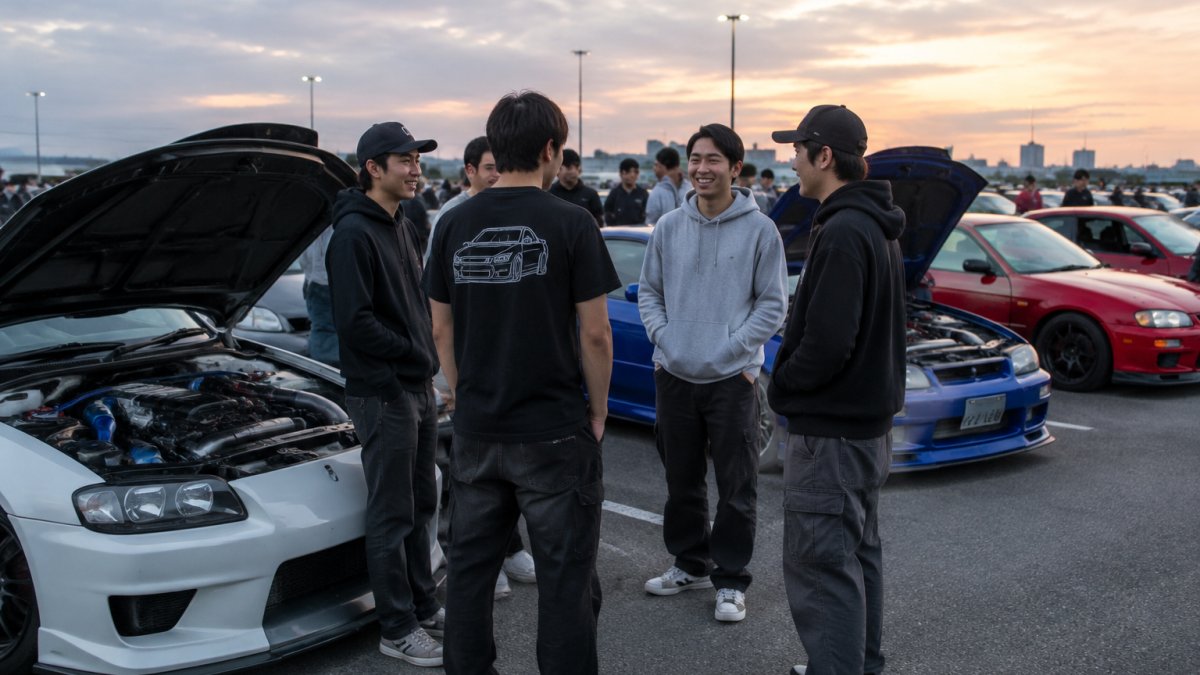
How to find them:
- Search local car community groups and event listings
- Ask at parts shops and tuning garages
- Check social media for recurring meet announcements
- Start with a large public show, then move to smaller gatherings
Walk up, ask about the car, and listen. Owners love talking about their builds. That single question is your entry ticket.
If you're planning your first late-night outing, our style guide for late-night car meets covers what to wear so you look like you belong.
Cars and Coffee Graphic T-Shirt →
Car-Meet Etiquette, Safety, and Legal Boundaries
Respect is the whole game. The community is welcoming, but it has rules, and breaking them gets you quietly excluded.
The basics:
- Ask before touching. Paint and carbon fiber are expensive.
- Don't rev your engine to show off in a crowded lot.
- Park where you're told and keep aisles clear.
- Take your trash with you.
- Keep it legal. Street racing is dangerous and illegal. Keep the speed off public roads and save it for sanctioned track days.
Watch out: filming people's plates and posting them without asking starts real arguments. Ask first.
The best meets stay friendly because everyone protects the space. Be the person who helps keep it that way.
JDM Car Culture on a Budget: What It Really Costs
You can enjoy this scene for very little money. The car is optional at the start. But if you do plan to buy, the purchase price is only the first line item. Most practitioners find the ongoing costs surprise beginners more than the sticker price does.
Where your money actually goes early on, before you own anything:
- Event entry - often free or a small fee for organized shows and weekend meets
- Apparel - one good shirt you'll wear constantly
- Learning - videos, forums, and build threads cost nothing
- Tools - only when you start doing your own work
When you do buy a car, budget for these before mods:
- Insurance - specialty or enthusiast coverage can differ from a standard policy, and modified cars may need to be declared
- Maintenance - tires, fluids, brakes, and timing components on an older performance car add up faster than on a commuter
- Parts - OEM and aftermarket availability varies by platform, and rare trim pieces can be hard to source
- Import compliance - if you are bringing in a Japanese-market vehicle, factor in shipping, customs, and any compliance work required for your country
- Project-car contingencies - a common pattern is a car that runs when bought but needs a clutch, suspension bushings, or rust repair within the first year
A running car with a maintenance reserve is worth more than a modified car that sits because the owner can't afford to fix it.
| Stage | Typical Spend | What You Get |
|---|---|---|
| Spectator | Free to low | Meet entry, learning, community |
| First gear | One shirt | Belonging, conversation starter |
| First car | Purchase plus upkeep | Ownership and hands-on learning |
| Builder | Parts plus tools | Real modification experience |
Start at the top of that table. Move down when you're ready, and only move down when the stage above it is comfortably covered.
Watch out: a cheap project car is rarely cheap once maintenance and compliance are counted. If the total budget only covers the purchase, you are not ready to buy yet.
Gear That Shows You Belong
Apparel is the easiest signal in car culture. A good graphic tee says "I'm here for the cars" without you saying a word.
That's our lane at Midnight Motor Club. We make graphic tees for people who live for the drive, with clean design and honest materials. Our Cars and Coffee Graphic T-Shirt is a graphic tee for car fans.

For something with more attitude, the "Dreamed It. Built It. Now We Go." Graphic T-Shirt speaks to the build-first mindset. And if you want beginner-friendly aesthetic ideas beyond clothing, our guide to JDM aesthetic mods for beginners covers the look from the car side.

Your First Step: Show Up to One Meet This Month
Pick a date. Find one meet. Go.
You don't need a car, a build, or a full vocabulary. You need to show up, ask one owner about their car, and listen. That's how everyone in this scene started.
At Midnight Motor Club, we make gear for that first step and every one after it. Our tees use clean design and honest materials. Browse the collection, pick a shirt that fits your style, and wear it to your first gathering. You'll have a conversation starter on your back. A shirt can open the conversation, and joining a car club can turn that first hello into a regular place in the local scene.
Get started with Midnight Motor Club and show up to your first meet looking like you've been part of the scene all along.
Frequently Asked Questions
What does JDM actually mean?
JDM stands for Japanese Domestic Market, meaning vehicles built and sold in Japan. Strictly, a true JDM car was made for Japanese roads, with right-hand drive and Japan-specific specs. In everyday use, enthusiasts often apply the term to Japanese-branded performance cars in general. Knowing the difference helps you avoid correcting people at meets, and it makes you sound like you actually know the scene rather than just repeating a hashtag.
Do you need to own a JDM car to be part of JDM car culture?
No. Plenty of people in the community start as passengers, photographers, or just regulars who show up and talk to owners. JDM car culture is built on shared interest, not ownership papers. Learn the models, ask good questions, and respect people's builds. You can be a genuine part of the scene for years before you buy anything, and nobody worth knowing will hold that against you.
How can I get into JDM car culture on a budget?
Start with free entry points: car meets, online build threads, video channels, and model-spotting at local shows. Your first real spend should be knowledge and a bit of gear, not a car. When you do buy, factor in insurance, tyres, fuel, and maintenance before the purchase price. A cheap project car that eats your savings is worse than waiting a year and buying something you can actually maintain.
What should I know before attending my first car meet?
Arrive early, park where you're told, and don't rev or burnout on the way out. Ask before touching anyone's car, keep your distance from open hoods unless invited, and don't criticize builds out loud. Bring a friend if you're nervous, and introduce yourself to whoever is standing by their car. Most owners are happy to talk about their build, and a genuine question about a part or swap goes further than any compliment.
