
Table of Contents
- Start With a Repeatable Garment Inspection Checklist
- How to Check Clothing Fabric Quality: Fiber, Weight, and Hand
- How to Check Garment Stitching and Seams Before You Buy
- How to Tell If a Graphic Tee Is Good Quality
- Hardware, Fit, and Stress Points That Signal High Quality Apparel
- How to Wash Graphic Tees Properly So They Keep Their Shape and Print
- Judging High Quality Apparel Online and by Cost Per Wear
- Conclusion
- Frequently Asked Questions
Last Updated: October 17, 2026
Start With a Repeatable Garment Inspection Checklist
Price tags and logos are unreliable. A repeatable inspection routine tells you more in 60 seconds than a brand name ever will, the core of how to identify high quality apparel.
At Midnight Motor Club, we build graphic tees for car people, so we handle a lot of fabric, seams and prints. Here is the quick pass we run on any garment:

- Fiber content: Read the care label. Natural fibers like cotton, linen and wool behave differently from synthetic blends.
- Fabric weight and hand: Does it feel substantial or thin? Does it drape or cling?
- Weave or knit: Hold it to the light. Can you see through it?
Run this list every time, in the same order. Consistency turns a vague feeling into a real judgment.
How to Check Clothing Fabric Quality: Fiber, Weight, and Hand
Fabric quality comes down to fiber, weight and hand feel.
Fiber content is the foundation. Cotton breathes and takes print well; linen wrinkles but lasts; wool holds warmth.
Fabric weight is measured in ounces per square yard or grams per square meter.
Fabric hand is the drape and feel. Quality apparel feels smooth and consistent, with no stiff patches or thin spots.
How to Check Garment Stitching and Seams Before You Buy
Good stitching is the clearest signal of garment construction quality. Turn the item inside out and look at the seams first. The outside is designed to look good; the inside is where construction decisions show.
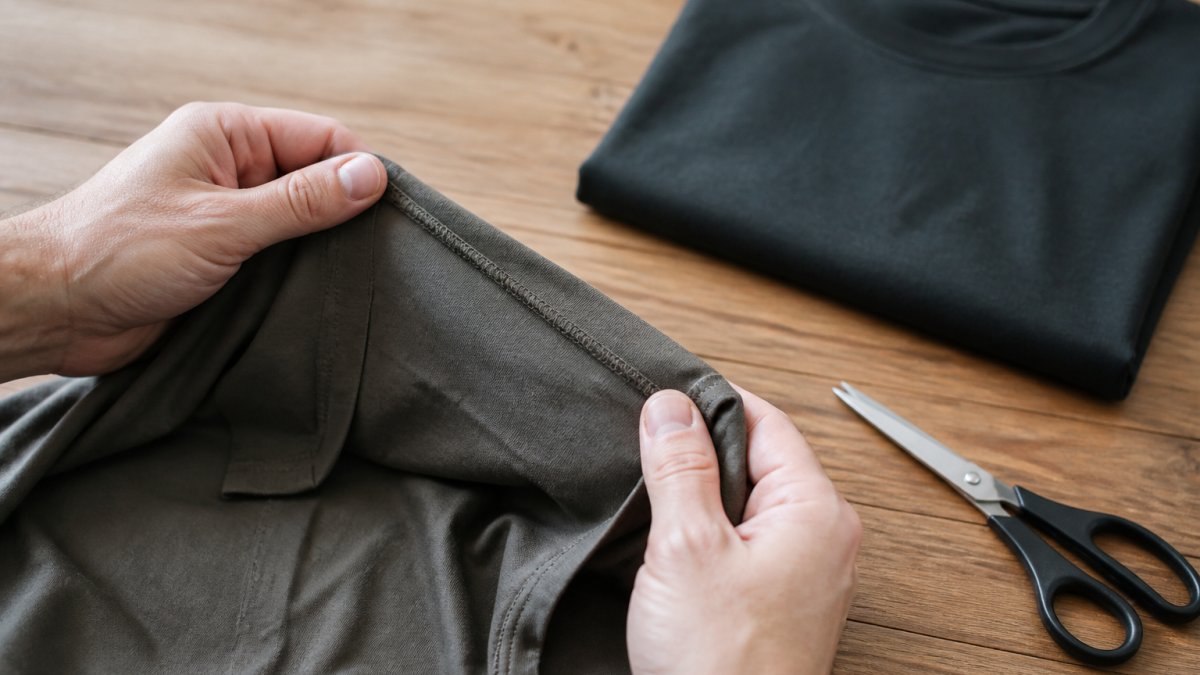
Read the stitch, not just the seam
Stitch type tells you how the seam was built and how it will behave under load.
- Straight stitch (lockstitch): The default on most seams. Look for 10-12 stitches per inch on lightweight fabric and 8-10 on heavier fabric. Sparse stitches pull apart; very tight stitches can pucker and weaken the fabric.
- Double-needle stitch: Two parallel rows of stitching, common on hems and shoulders. It distributes stress across two lines of thread and is a good sign on high-wear areas.
- Overlock (serged) stitch: The looped stitch that wraps the raw edge. It should be tight and consistent, with no gaps where the fabric edge peeks through.
Check the seam finish
A seam is only as good as its edge treatment. Raw edges fray; finished edges survive washing.
- Serged edges: The most common finish on knits. Look for dense, even loops and no exposed raw fabric.
- Bound edges: A strip of fabric wraps the seam allowance. Common on higher-end knits and necklines; it resists fraying and feels smooth against skin.
- Flat-felled seams: The seam allowance is folded and stitched down, so no raw edge is exposed. Common on denim and workwear; strong but bulky.
Inspect the stress points specifically
- Shoulders: Look for double-needle stitching or a taped seam. A single line of stitching on a shoulder seam is a weak point.
- Armholes: Check for even serging and no puckering. Armhole seams take constant motion.
- Side seams: Run your finger along the seam. It should be flat and consistent, with no twists or skipped stitches.
Spot the warning signs
- Skipped stitches: Gaps in the stitch line where the thread did not catch the fabric.
- Puckering: Fabric bunching along the seam, often from tension problems or mismatched feed.
- Wandering stitch lines: Stitches that drift away from the seam allowance.
How to Tell If a Graphic Tee Is Good Quality
A good graphic tee passes four tests: solid fabric, clean seams, a print that sits in the fabric rather than on top of it, and hardware that holds up.
Start with the fabric. A heavyweight cotton tee with a substantial hand will hold its shape and support a print. Thin fabric stretches, and the graphic distorts with it.
Then check the print itself:
- Feel the print: A print that sits flat and slightly into the fabric usually lasts longer than a thick, rubbery layer.
- Stretch test: Gently stretch the printed area. Cracking at the edges is a bad sign.
- Check the edges: Sharp, clean print edges suggest better application.
Fit and shape retention round it out. Hold the shirt up. Does it hang evenly, or does one side pull? Uneven cut usually means uneven construction.
Our Driven to Build T-Shirt is a good example of what to look for: cotton construction, a crew neck, and a print applied with direct-to-garment and embroidery work rather than a cheap heat transfer.

Hardware, Fit, and Stress Points That Signal High Quality Apparel
Hardware and stress points are where cheap garments give themselves away. Buttons, zippers, buttonholes, pockets, cuffs and armholes all take constant abuse.
Check these:
- Buttons: Thick, securely stitched, with a clean finish. Wiggle them. Loose buttons mean rushed construction.
- Buttonholes: Neatly bound and evenly sized. Ragged buttonholes fray fast.
- Zippers: Smooth glide, no catching, and a pull that feels solid.
Shape retention separates quality apparel from disposable clothing. A good garment returns to its shape after stretching. A poor one stays stretched.
Driven to Build T-Shirt | Construction, Builder Typography Tee →
Stretch recovery matters too: if the fabric sags after a gentle pull and doesn't spring back, it will bag out at the elbows and knees.
How to Wash Graphic Tees Properly So They Keep Their Shape and Print
Washing correctly is the easiest way to extend garment lifespan. Most print damage comes from heat and friction, not from wearing the shirt.
Follow these steps:
- Turn the tee inside out. This protects the print from rubbing against other garments.
- Wash cold. Heat breaks down prints and causes shrinkage. Cold water is gentler on both.
- Use a mild detergent. Harsh formulas strip color and weaken fibers.
- Skip the fabric softener. It coats fibers and can dull prints.
- Tumble dry low or hang dry. High heat is the main cause of cracked graphics.
- Do not iron directly on the print. Use low heat and press from the inside.
Our While The World Sleeps We Build T-Shirt is garment-dyed and pre-shrunk, with care instructions that call for cold machine washing, low tumble drying and no dry cleaning. Follow the care label on any garment and you will avoid most of the damage people blame on the brand.
Judging High Quality Apparel Online and by Cost Per Wear
Buying online removes your hands from the equation, so replace touch with evidence. Brand trust and star ratings don't tell you how a garment is built. Treat the product page as a construction document and read it the way you'd read the inside of a shirt.
Build an evidence file before you buy
Collect these signals in order. If a brand is missing several, that's itself information.
- Fiber composition: Listed as percentages, not vague words like "cotton blend." A brand that hides its materials is telling you something.
- Fabric weight: Stated in oz/yd² or gsm where possible. A heavyweight tee is typically in the 5.5-6.5 oz range; lighter fashion tees often sit under 4.5 oz. If weight is not listed, look for descriptors like "heavyweight" or "midweight" and treat them as claims to verify in reviews.
- Construction details: Close-up photos of seams, hems, necklines, and hardware. A page that only shows the front of the garment is hiding the inside.
Run the return-risk checks
Return risk is where online quality judgments get tested. Before you buy, ask:
- If the fabric is thinner than expected, can I return it?
- If it shrinks after the first wash, is that covered?
- Is the return window long enough to wash and wear it once?
A generous, clearly written return policy lowers the cost of being wrong. A restrictive one raises the effective price of every uncertain purchase.
Use cost per wear, not sticker price
Cost per wear is the honest way to compare price versus quality. Divide the price by the number of times you expect to wear it.
- A tee at $32.99 worn fifty times costs about 66 cents per wear.
- A cheaper shirt that cracks after five washes costs more per wear and ends up in the trash.
Cost per wear is only as good as your lifespan estimate, so anchor it in evidence: fiber, weight, seam construction and care. A well-made garment washed correctly will outlast a cheap one every time.
Know what online inspection cannot tell you
Some qualities don't survive a product page: drape, exact hand feel, color accuracy under different lighting, and how the garment moves on your body. For those, rely on return policy and reviews rather than photos. Free returns plus detailed reviews make trying low-risk; without either, the burden of proof is on the product page, and most pages don't meet it.
That is the case for paying more. Not for a logo, but for honest materials and construction that hold up. Our "Pop the Hood" T-Shirt is garment-dyed cotton with a relaxed fit, built for everyday wear rather than a single wash.

Conclusion
The gap between quality apparel and disposable clothing comes down to a few checks most people never run: fiber content, fabric weight, seam construction, stress points, hardware and care. Learn to read those signals and price stops being your only guide.
At Midnight Motor Club, we build tees for people who live for the drive, using clean design and honest materials so the gear lasts as long as the obsession.
Frequently Asked Questions
How can you tell if clothing is high quality?
Turn the garment inside out and read the care label first. Check fiber content, then look at seam allowance width, stitch evenness, and whether stress points like shoulders and armholes are reinforced. Feel the fabric for weight and opacity, and look for loose threads or skipped stitches. A garment that passes those checks usually keeps its shape and color through repeated washing, which is what separates high quality apparel from a shirt that looks fine on the rack and falls apart in a month.
Does heavier fabric mean better-quality clothing?
Not automatically. Heavier fabric often means more durability and better drape, which is why a 6.1 oz cotton tee feels more substantial than a thin 4 oz one. But weight alone does not guarantee quality. A heavy fabric with short staple fibers can still pill and shrink, and a lighter fabric with tight, even construction can outlast it. Use weight as one signal alongside fiber content, stitch quality, and how the fabric recovers when you stretch it.
How should you wash graphic tees to help them last?
Wash graphic tees inside out in cold water, max 30C, on a gentle cycle. Skip bleach and fabric softener, which break down cotton fibers and dull prints. Tumble dry on low heat or hang dry, and iron on low heat on the reverse side only, never directly on the graphic. Following the sewn-in care label is the safest rule, and cold washing plus low-heat drying is the single biggest factor in keeping a print from cracking.
What are signs that a garment is poorly made?
Loose threads at the seams, skipped or uneven stitches, and narrow seam allowances that fray after a wash are the clearest warnings. Also watch for prints that feel thick and rubbery, buttonholes with ragged edges, zippers that catch, and fabric that goes see-through when held to light. If the care label is missing or the fiber content is vague, treat that as a red flag. These issues usually show up within a few wears, so catching them in-store saves you the return.